Copyright Infringement Enforcement & Defense in New York
This page focuses specifically on copyright infringement: enforcing your exclusive rights against unauthorized copying and defending clients accused of infringement. If your concern is broader intellectual-property strategy, see our intellectual property attorneys page; for brand and logo disputes see trademark attorneys; and for confidential business information see our trade secret attorneys page. Below, we concentrate on the federal copyright claims, DMCA procedures, and litigation venues most relevant to New York creators and businesses.
Why Copyright Infringement Cases Are Filed in New York Federal Courts
Copyright is governed exclusively by federal law (the Copyright Act of 1976, 17 U.S.C. §§ 101 et seq.), and federal courts have exclusive jurisdiction over infringement claims under 28 U.S.C. § 1338. State courts cannot hear them. For clients in New York City and the surrounding area, that means a copyright lawsuit is almost always filed in one of two courts:
- U.S. District Court for the Southern District of New York (SDNY): covering Manhattan and the Bronx, plus Westchester, Rockland, Putnam, Dutchess, Orange, and Sullivan counties. The SDNY hears a large share of the nation's media, publishing, music, and fashion copyright disputes.
- U.S. District Court for the Eastern District of New York (EDNY): covering Brooklyn, Queens, Staten Island, Nassau, and Suffolk counties.
Venue in copyright actions is governed by 28 U.S.C. § 1400(a), which allows suit in any district where the defendant or its agent resides or may be found. Because so many publishers, galleries, agencies, and online platforms are located in or do business in New York, the SDNY and EDNY are frequently proper venues even against out-of-state defendants. Choosing the right district (and anticipating the case law a particular court has developed on issues like substantial similarity and fair use) is a meaningful strategic decision we evaluate at the outset.
Registration Must Come First: The Fourth Estate Rule
One of the most consequential (and most misunderstood), requirements is registration timing. While copyright protection attaches automatically the moment an original work is fixed in a tangible medium, you generally cannot file an infringement lawsuit until the U.S. Copyright Office has acted on your application. In Fourth Estate Public Benefit Corp. v. Wall-Street.com, 586 U.S. 296 (2019), the Supreme Court held that "registration" under 17 U.S.C. § 411(a) means the Copyright Office has actually granted (or refused) registration, not merely that an application was submitted.
Standard Copyright Office processing can take many months, so for time-sensitive matters we frequently use the Copyright Office's special handling (expedited) procedure, which carries an additional fee but can produce a registration in days when litigation is imminent.
Registration timing also drives remedies. Under 17 U.S.C. § 412, statutory damages and attorney's fees are available only if the work was registered before the infringement began (or within three months of first publication). A creator who registers promptly preserves powerful leverage; one who waits is often limited to provable actual damages and the infringer's profits.
Damages and Remedies: Stated Accurately
The Copyright Act offers two paths to monetary recovery, and a copyright owner generally elects between them:
- Actual damages plus the infringer's profits (17 U.S.C. § 504(b)), your lost licensing revenue or market harm, plus any profit the infringer earned that is attributable to the infringement and not already counted in actual damages.
- Statutory damages (17 U.S.C. § 504(c)), ranging from $750 to $30,000 per work infringed, as the court considers just. Where the infringement is willful, the court may award up to $150,000 per work. Where the infringer proves it was an innocent infringer, the court may reduce the award to as low as $200 per work.
Additional remedies include injunctions (17 U.S.C. § 502) to stop ongoing infringement, impoundment and destruction of infringing copies (§ 503), and, where statutory prerequisites are met, costs and attorney's fees (§ 505). For unauthorized circumvention of technological protection measures or removal of copyright management information, the Digital Millennium Copyright Act (DMCA) provides separate claims under 17 U.S.C. §§ 1201–1203.
DMCA Takedowns: A Faster First Step for Online Infringement
Much of the infringement our New York clients face is digital, an image lifted for an ad campaign, a song uploaded to a streaming platform, an article reposted in full, a photograph used on a competitor's website. Before, or alongside, litigation, we often pursue a DMCA takedown notice under 17 U.S.C. § 512(c), which compels qualifying online service providers to remove infringing material to maintain their safe harbor.
A defective notice can be ignored, and an overreaching one can expose the sender to liability under § 512(f) for material misrepresentation, and courts (following Lenz v. Universal Music) expect the sender to consider fair use before submitting. We draft notices that are legally sufficient, handle counter-notifications, and advise on when a takedown should be escalated to a federal complaint.
Proving Infringement: Access and Substantial Similarity
To prevail, a copyright owner must show (1) ownership of a valid copyright and (2) copying of original elements of the work. Because direct evidence of copying is rare, infringement is usually proven circumstantially through access to the original plus substantial similarity between the works. The Second Circuit (whose decisions bind the SDNY and EDNY) applies a refined "ordinary observer"/"more discerning observer" analysis and filters out unprotectable elements such as ideas, facts, and scènes à faire before comparing what remains.
We build the evidentiary record with deposit copies, version histories, metadata, forensic comparisons, and licensing records, and we frame the protectable-expression analysis to fit Second Circuit precedent.
Fair Use Defense in the Second Circuit
Fair use under 17 U.S.C. § 107 is the most common defense, evaluated through four statutory factors: the purpose and character of the use (including whether it is transformative), the nature of the copyrighted work, the amount and substantiality used, and the effect on the potential market. The analysis has shifted meaningfully in recent years, the Supreme Court's decision in Andy Warhol Foundation v. Goldsmith, 598 U.S. 508 (2023), a case arising from this region, narrowed how courts treat "transformative" purpose, especially where the secondary use competes commercially with the original. We apply the current state of the law (not outdated assumptions about transformation) whether we are asserting or defending against a fair use claim.
Industry-Specific Disputes We Handle in New York
New York's concentration of creative and media businesses shapes the matters we see:
- Photographers and visual artists: unlicensed use of images in advertising, on websites, and on social media; see our related photographs attorney page.
- Publishers, authors, and journalists: wholesale reposting of articles and books that undermines subscriptions and licensing.
- Music: sampling, synchronization, and unauthorized distribution disputes.
- Fashion and design: copying of original fabric prints, patterns, and graphics (note that useful articles receive only limited protection under Star Athletica).
- Software and digital products: copying of code and creative assets.
- Galleries, agencies, and licensors: enforcing or defending licensing terms and infringement claims.
Our Enforcement and Defense Process
Every matter is different, but a copyright dispute typically moves through some combination of these steps:
- Assessment. We confirm ownership, registration status, and registration timing under § 412 to determine which remedies are realistically available.
- Demand or DMCA notice. A cease-and-desist letter or § 512(c) takedown often resolves the issue without litigation.
- Registration / expedited handling. If a lawsuit is likely, we secure or expedite registration to satisfy Fourth Estate.
- Litigation. We file in the SDNY or EDNY, pursue early injunctive relief where appropriate, and conduct discovery aimed at access, substantial similarity, willfulness, and profits.
- Resolution. Most cases settle through negotiated licenses, takedown undertakings, or payment; we try cases when settlement is not in the client's interest.
On the defense side, we evaluate fair use, independent creation, license and implied-license defenses, the innocent-infringer reduction, statute-of-limitations issues (a three-year limitations period under 17 U.S.C. § 507(b)), and registration and standing defects in the plaintiff's case.
A Note on Criminal Copyright Matters
Most copyright infringement is a civil matter. However, willful infringement for commercial advantage can be prosecuted criminally under 17 U.S.C. § 506 and 18 U.S.C. § 2319, and the U.S. Attorney's Office for the Southern District of New York has pursued large-scale piracy and counterfeiting operations. We advise rights holders on referral options and counsel clients who face exposure.
Speak With a New York Copyright Lawyer
In enforcing your rights against an infringer or defending against a claim, the early decisions (registration timing, venue, takedown versus litigation, and the strength of a fair use position) often determine the outcome. We are the Law Offices of Albert Goodwin, located in New York, NY. Call 212-233-1233 or email [email protected] to discuss your copyright infringement matter.
This page is general legal information about copyright infringement under federal law and New York federal court practice. It is not legal advice and does not create an attorney-client relationship. Outcomes depend on the specific facts of each matter.
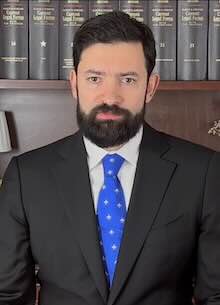
About the Author
Albert Goodwin Esq. is a licensed New York attorney with over 18 years of courtroom experience. His extensive knowledge and experience make him well-qualified to write authoritative articles on a wide range of legal topics. He can be reached at 212-233-1233 or [email protected].